Former Captain Won’t Be Returning To Arsenal On This Day, 2nd June 1958

Joe Mercer had been coaxed out of retirement from playing following the 1953 title win for another season. When Jack Crayston’s unsuccessful reign reached its conclusion, the former captain was the preferred candidate to replace him as Arsenal manager when the role became vacant.

Sheffield United had given him his break in the management game and stood by him when the club was relegated at the end of his first season in charge. No doubt that loyalty played a part in the decision although reading between the lines of his comments, the Arsenal role was turned down somewhat reluctantly.

Ron Greenwood is mentioned as a possible replacement but remained on the staff not considered for the top job. He left for West Ham in December 1961, four months or so before Crayston’s eventual replacement, George Swindin vacated the manager’s office in May 1962.

Alex James Of Arsenal Passes Away On This Day, 1st June 1953

Alex James died on this day fifty-nine years ago. Such was his standing in the game, his passing made the front page of The Daily Express. Below are fitting tributes, underlining the respect in which he was held. Included below is a series of articles from George Allison that were carried in the following week’s Daily Express.

Ken Friar On Crowd Control, Arsenal On This Day, 31st May 1985

1985 was a grim year for English football. The FA Cup Sixth Round encounter at Kenilworth Road in March had seen Millwall fans run amok from before kick-off; Heysel; a teenage boy died at Birmingham. Margaret Thatcher presented her brainwave of ID Cards via her lapdog Minister for Sport, Colin Moynihan (now Lord and Chairman of BOA).

Cures had been in short supply with football authorities and governments over the years failing to grapple with the social issues that were intertwined with the hooliganism problem.  Suggestions over the years had ranged from segregation through to the ill-conceived electric fences proposed for Stamford Bridge by Ken Bates. Stadia at the time were decrepit at best; facilities now that seem embarrassing to think of. Treating the supporters like animals merely served to imflame situations.

Relatively speaking, Highbury was at that time reasonably safe to visit. There were problems, a barrier gave way in 1972 against Derby in an FA Cup tie whilst West Ham had made some infamous visits to the North Bank. There were incidents but compared to other grounds, these were not as plentiful. At a time when violence was reaching it’s low point, Arsenal had relatively few arrests as noted by Ken Friar below.

The article gives an interesting insight into the club’s view on the issue.

A True Arsenal Legend Passes On This Day, 30th May 1995

A fitting tribute from The Guardian’s David Lacey to mark the death of Ted Drake. The only missing information about that match at Villa Park was that the one shot Ted had which did not find the back of the net, struck the woodwork which the club site observes appeared to have crossed the line.

Arsenal Won’t Run Away From Their Brazilian Tour On This Day, 29th May 1949

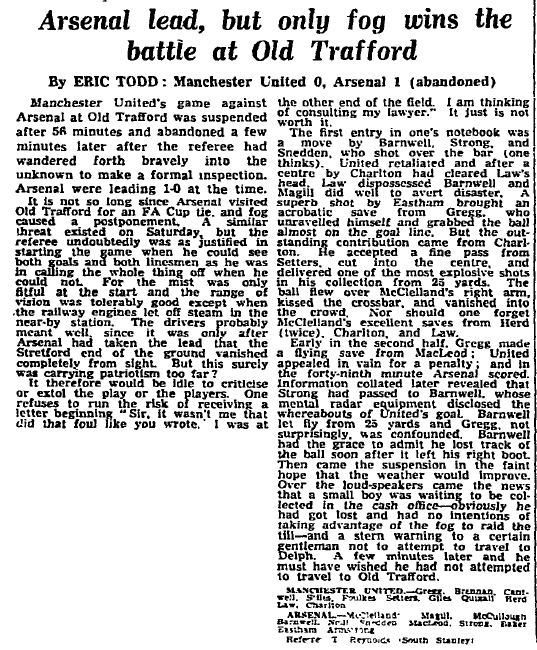
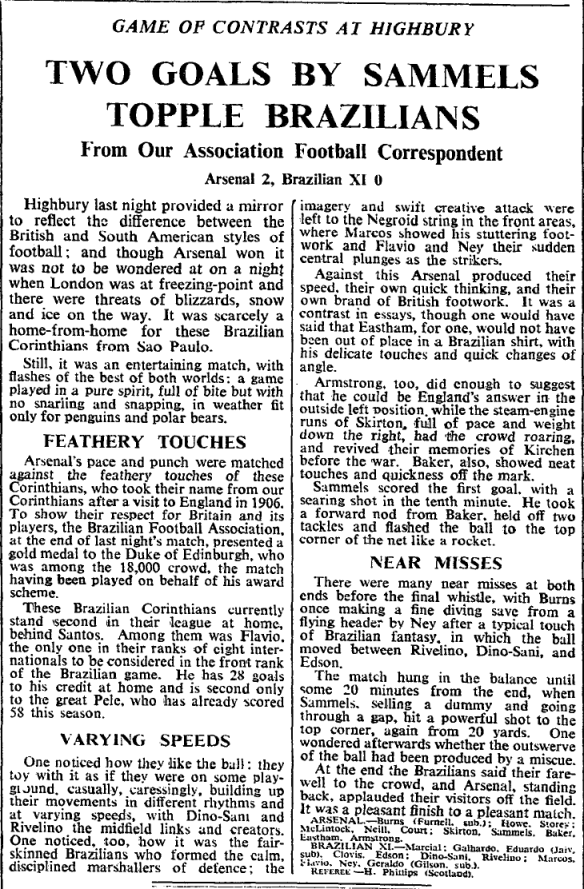
The 1949 tour of Brazil had started well but looking at the schedule, it is hardly surprising that it ended with mixed results. Previous reports from the tour had praised Arsenal’s style on and off the pitch. Even in the midsts of provocation, the players seem to have come out with their reputations intact.

All Hail The Conquering Arsenal Heroes On This Day, 28th May 1989

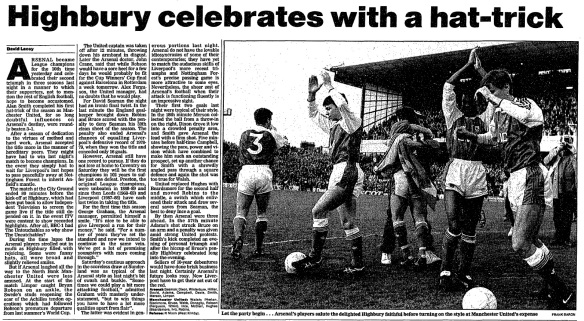
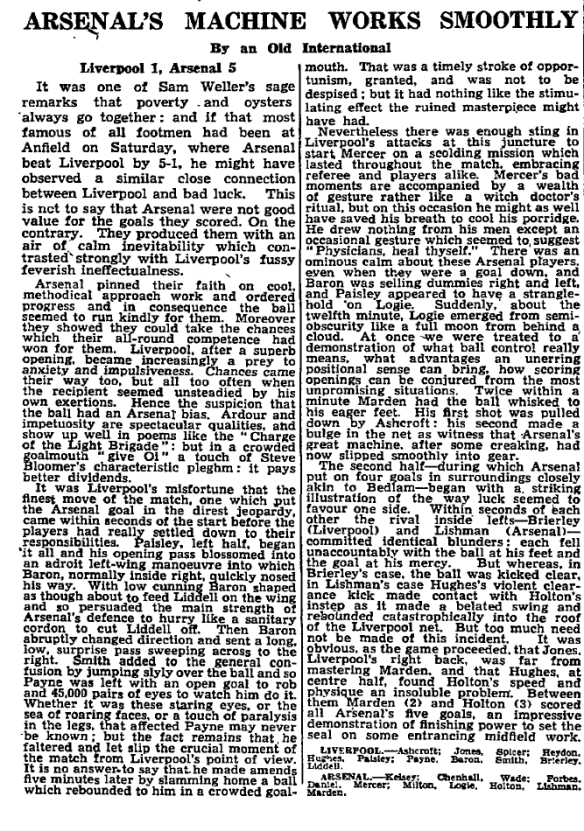
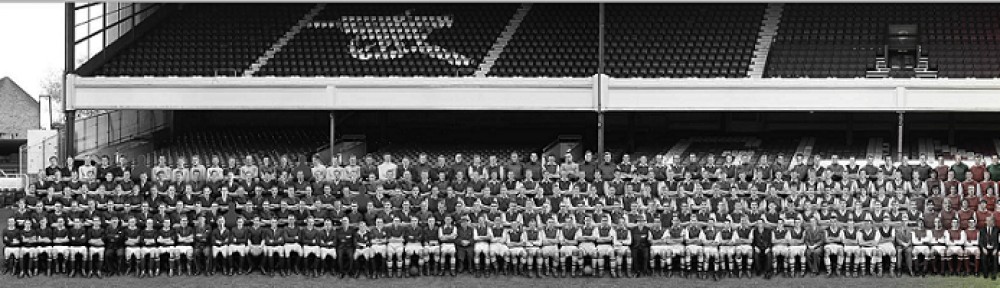
That night in Anfield was still fresh in many minds. For a significant portion of the crowd – myself included – this was the first time that we had seen Arsenal players parade the League Championship trophy. Hangovers were shrugged off with a fresh top up of whatever induced them in the first place to witness the event. In my mind’s eye, I am quite near the front. Judging by the photo below, I doubt that I was.


Arsenal Don’t Want To Pay Big Transfer Fees On This Day, 27th May 1923 (Or Any Other Day For That Matter)

With hindsight, there is nothing unusual about Arsenal not wanting (or being able) to pay high transfer fees. Nearly ninety years ago they actually tried to limit them; how would the history of football look now? In today’s game, player salaries would no doubt be considerably higher although matters might not be so simple with clubs who survive on transfer income, severely limited in their ability to pay high salaries. In all likelihood, the status quo would have been maintained with the rich getting richer.

Combined with the maximum wages for players, it would have made football finances a lot more certain, with the transfer market possibly regulated by how much money clubs needed to make to survive.

Setting the fee at £1,650 seems perverse and it is little wonder that Norris’ proposal failed. Early in 1922, the English transfer record had moved from its pre-war record of £2,500 through £5,000 to £5,500. The level proposed by Norris was unfeasibly low which begs the question as to why it was suggested. It is unreasonable to view the move as saying more about the state of Arsenal’s finances than anything else.

Quite possibly, it was a move on his part to allow Arsenal to make the leap into challenging for silverware, enabling them to buy sufficient quality of players ‘on the cheap’. We may never know the true motives of the move.

Arsenal Expects Every Man To Do His Duty On This Day, 26th May 1989

No matter how much the broadcasters of today might try to paint the end of the 2011-12 season as the most exciting in the history of the game, it was not. Nowhere near. 1st v 2nd for the title, home of the leaders, still the dominant force in English football. 2nd place team requires a two-goal victory, a margin of defeat that the home side had not tasted on their own ground in over three years.

Having procured our tickets barely a fortnight earlier, arrangements were made for the meet-up in Guildford. Time off work secured, the pub beckoned and that last pint was almost costly. Welcome though as we travelled to Anfield in Larry’s van; an escort with room for driver and a passenger in the front, third person in the back. No seats. Still, fairs fair, one person in the back on the way up, the other on the way home. Alcohol certainly helped with the bruises suffered, numbing my pain as Anfield drew closer.

Hearing “A Place In The Sun” by The Men They Couldn’t Hang – a band I used to see regularly with Jon and Al – on the radio as the sun shone through the windscreen brought a sense of well-being, a rarely heard single in those days (in any day) seemed to make the day complete. Anywhere inside the Home Counties was considered fair game for a TMTCH gig. What memories of those nights as well; dodgy pubs in Harlesden (I knew the Cork branch of the family would come in useful some day); dubious hairs in a raita, never stopping to find out what joys the curry would bring; ales quaffed here, there and quite possibly everywhere; tales for another arena.

Nothing prepared us for the traffic though; horrendous to the extent that we just made kick-off. And the match. I remember snatches of it, quite big chunks from our vantage point by a terrace entrance, close to the home fans. Alan Smith’s goal? Surely he touched it? Didn’t he? The opinions of the officials were all that counted and not enough credit was given to the referee and linesman for having the strength of character to withstand the pressure from Liverpudlian players and supporters alike.

Mickey Thomas blew it. Grobbelaar saved a tame shot with what seemed like minutes to go and then the glorious moment. As the ball hit the back of the net, I felt lifted by the wave of emotion, genuinely leaving my feet, turning and sinking to my knees in the open space with   an old couple standing in the entrance to the terrace, tears in the man’s eyes. It remains and difficult moment to capture in words; sheer undiluted joy. The lifetime of disappointment before and since can be forgotten with moments like this.

Even the bricks that rained in on us from the footbridge as we left the city could not dim the moment. I wonder what happened to those kids as several cars pulled in and gave chase. I don’t actually, it doesn’t take too much imagination.

I bought a copy of each newspaper the following morning. And on the Sunday as well. For a month or two, I bought every football magazine that was published. All the clippings and a photocopy of my matchday programme and the ticket are in a scrapbook which still sees the light of day every now and then.

It was an amazing night and even though I enjoy title wins and cup triumphs, nothing comes close to the emotions of that night in May.

(Click on images to enlarge)

Getting Ready For The Big One, Arsenal On This Day, 25th May 1989

A day to go and a bullishness was emerging, not surprising from the Arsenal camp but who would have thought that Johnny Giles would have supported a north London title victory. Still, at least James Lawton has a track record of backing the wrong horse.

(Click to enlarge images)

But Paul Merson and John Aldridge had problems to distract them…


Three Future Arsenal Managers Play For Arsenal On This Day, 24th May 1967

Three future Arsenal managers in one Arsenal line-up. This might have only been a friendly but it must be unique to have had three players in the first team squad who would then go on to manage the club in question. It says something of the calibre of players that Arsenal produce or a sign of the intelligence of the players signed.

The three in question were Terry Neill, Don Howe and George Graham. Neill would play regularly with either of his successors; injury to Don Howe meant that the three never featured in a competitive match together. If you add George Armstrong and Bob Wilson to that list in recognition of their coaching at the club, nearly half of the team would continue to work for Arsenal when their playing days were over.

The line-up this day for Arsenal was:

  1. Wilson
  2. Howe
  3. McNab
  4. Simpson
  5. Neill
  6. Coakley
  7. Addison
  8. Graham
  9. Radford
  10. Sammels
  11. Armstrong

There is some doubt about the line-up as some reports have suggested that Jim Furnell started the match, replaced early on by Bob Wilson. Either way, the quintet were on the pitch for a fair amount of the match.

Of the remainder of the starting XI, only Sammels and Simpson did not actively pursue a career in the game after retiring as players. John Radford managed Bishops Stortford whilst Bob McNab went to coach in the USA and even took over as caretaker boss at Portsmouth after Alan Ball’s dismissal, having pitched up there originally as part of the consortium fronted by Milan Mandaric to buy the club.

Colin Addison would also go on to have a relatively successful managerial career which included being in charge of Hereford United during their successful 1971-72 FA Cup run that saw them beat Newcastle United with that goal from Ronnie Radford, before moving to the Middle East and Spain for short spells.